


OM System OM-5 II Comparison Review
The OM System OM-5 II is a mirrorless interchangeable lens camera that was revealed to the public in June 2025 and is equipped with a Four Thirds sensor. It offers a resolution of 20.2 megapixel.
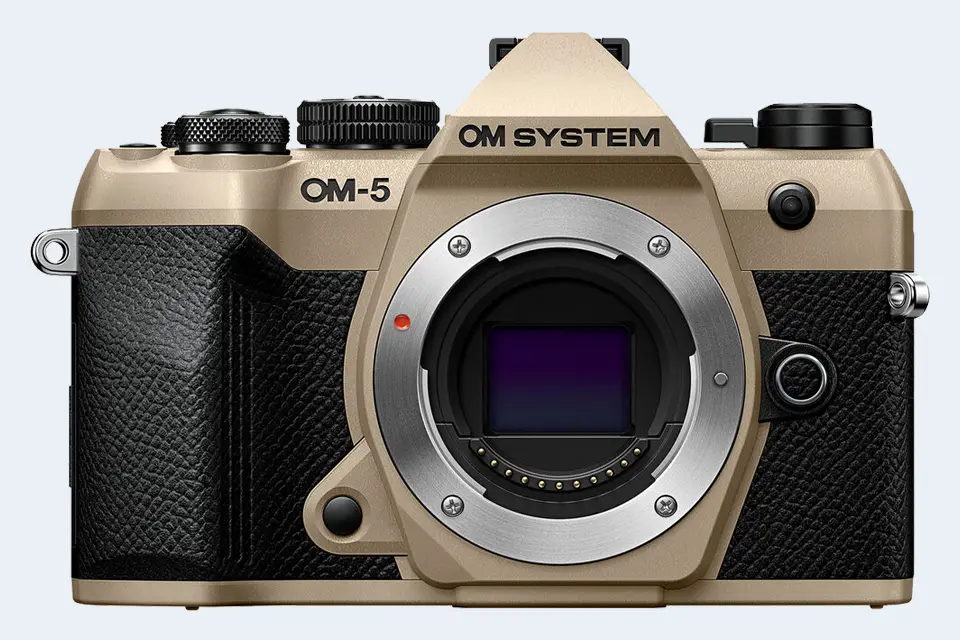
Is the OM System OM-5 II a good camera? The OM-5 II has a Camera Elo of 2664. This rating puts the OM-5 II among the top 40 percent of all mirrorless interchangeable lens cameras. In terms of its sensor size category (Four Thirds cameras), the OM-5 II ranks among the top 20 percent. Based on its within category standings, the camera earns a 4-star performance rating.
| OM System OM-5 II |
|---|
| Mirrorless system camera |
| Micro Four Thirds lenses |
| 20.2 MP, Four Thirds Sensor |
| 4K/30p Video |
| ISO 200 - 25 600 |
| Electronic viewfinder (2360k dots) |
| 3.0 LCD, 1040k dots |
| Swivel touchscreen |
| 10 shutter flaps per second |
| In-body stabilization |
| Weathersealed body |
| 310 shots per battery charge |
| 125 x 85 x 50 mm, 414 g |

Read on to find out more about the camera's size, sensor, features, reception by expert reviewers, and how it compares to other digital cameras.

Body comparison with a credit card
The side-by-side display below illustrates the physical size of the OM System OM-5 II vis-à-vis a credit card. Three successive views from the front, the top, and the rear are shown. All width, height and depth dimensions are rounded to the nearest millimeter.
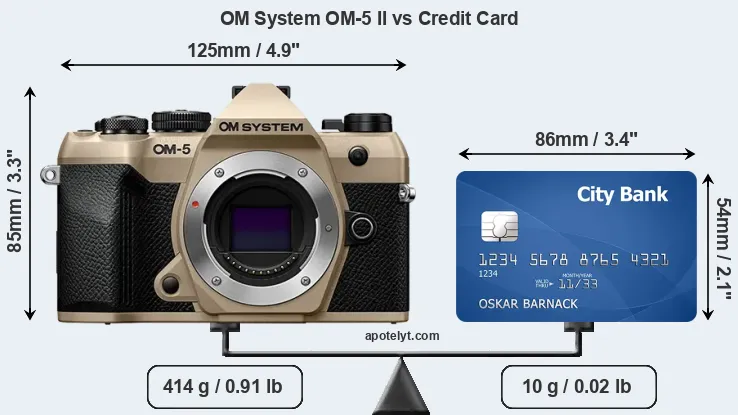
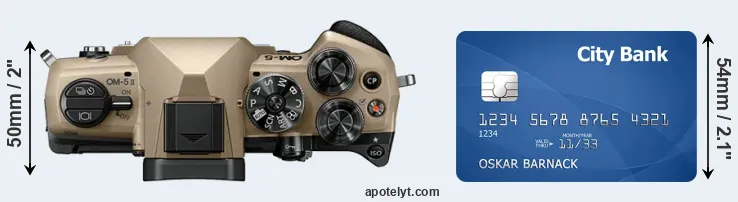
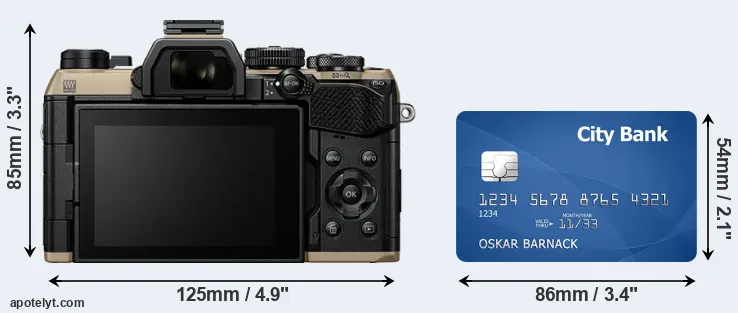
The table below summarizes the key physical specs of the OM System OM-5 II alongside a set of similar cameras. If you want to review a particular camera pair side-by-side, just move across to the CAM-parator tool and choose from the broad selection of possible comparisons there.
| Camera Model |
Camera Width |
Camera Height |
Camera Depth |
Camera Weight |
Battery Life |
Weather Sealing |
Camera Launch |
Launch Price |
Street Price |
||
|---|---|---|---|---|---|---|---|---|---|---|---|
| 1. | OM System OM-5 II | 125 mm | 85 mm | 50 mm | 414 g | 310 | Y | Jun 2025 | US$ 1 199 | amazon.com | |
| 2. | Olympus E-M5 III | 125 mm | 85 mm | 50 mm | 414 g | 310 | Y | Oct 2019 | US$ 1 199 | ebay.com | |
| 3. | Olympus PEN-F | 125 mm | 72 mm | 37 mm | 427 g | 330 | n | Jan 2016 | US$ 1 199 | ebay.com | |
| 4. | OM System OM-1 | 135 mm | 92 mm | 73 mm | 599 g | 520 | Y | Feb 2022 | US$ 2 199 | ebay.com | |
| 5. | OM System OM-1 II | 135 mm | 92 mm | 73 mm | 599 g | 500 | Y | Jan 2024 | US$ 2 399 | amazon.com | |
| 6. | OM System OM-3 | 139 mm | 89 mm | 46 mm | 496 g | 590 | Y | Feb 2025 | US$ 1 999 | amazon.com | |
| 7. | OM System OM-5 | 125 mm | 85 mm | 50 mm | 414 g | 310 | Y | Oct 2022 | US$ 1 199 | amazon.com | |
| 8. | Panasonic G90 | 130 mm | 94 mm | 77 mm | 536 g | 290 | Y | Apr 2019 | US$ 999 | ebay.com | |
| 9. | Panasonic GX8 | 133 mm | 78 mm | 63 mm | 487 g | 330 | Y | Jul 2015 | US$ 1 199 | ebay.com | |
| 10. | Sony A6500 | 120 mm | 67 mm | 53 mm | 453 g | 350 | Y | Oct 2016 | US$ 1 399 | ebay.com | |
| 11. | Sony A6600 | 120 mm | 67 mm | 69 mm | 503 g | 810 | Y | Aug 2019 | US$ 1 399 | amazon.com | |
| Note: Measurements and pricing do not include easily detachable parts, such as add-on or interchangeable lenses or optional viewfinders. | |||||||||||
The listed prices provide an indication of the market segment that the manufacturer of the cameras have been targeting. The OM System OM-5 II was launched in the US market at a price of $1,199. Usually, retail prices stay at first close to the launch price, but after several months, discounts become available. Later in the product cycle and, in particular, when the replacement model is about to appear, further discounting and stock clearance sales often push the camera price considerably down. Then, after the new model is out, very good deals can frequently be found on the pre-owned market.

Check OM-5 II price at
amazon.com
Sensor comparison with a 35mm slide
The imaging sensor is at the core of digital cameras and its size is one of the main determining factors of image quality. A large sensor will generally have larger individual pixels that offer better low-light sensitivity, provide wider dynamic range, and have richer color-depth than smaller pixels in a sensor of the same technological generation. Furthermore, a large sensor camera will give the photographer more possibilities to use shallow depth-of-field in order to isolate a subject from the background. On the downside, larger sensors are more costly to manufacture and tent to lead to bigger and heavier cameras and lenses.
The OM System OM-5 II features a Four Thirds sensor and has a format factor (sometimes also referred to as "crop factor") of 2.0. Within the spectrum of camera sensors, this places the OM System OM-5 II among the medium-sized sensor cameras that aim to strike a balance between image quality and portability.
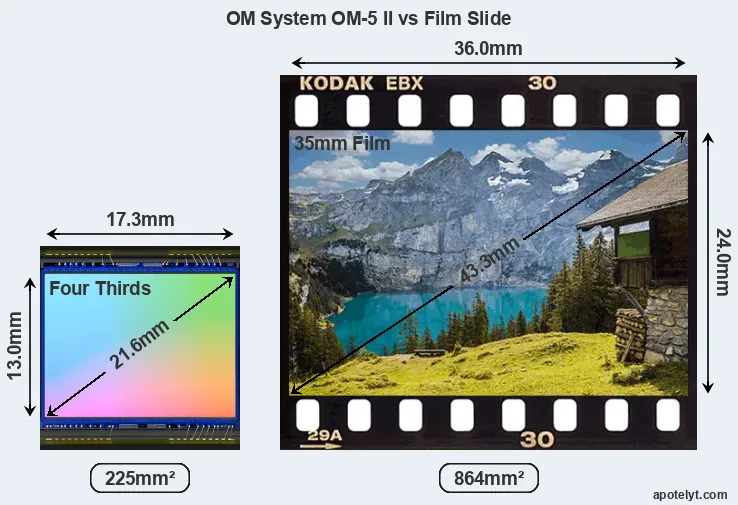
For most cameras, data on sensor performance has been reported by DXO Mark. This service is based on lab testing and assigns an overall score to each camera sensor, as well as ratings for dynamic range ("DXO Landscape"), color depth ("DXO Portrait"), and low-light sensitivity ("DXO Sports"). The table below summarizes the physical sensor characteristics and sensor quality findings and compares them across a set of similar cameras.
| Camera Model |
Sensor Class |
Resolution (MP) |
Horiz. Pixels |
Vert. Pixels |
Video Format |
DXO Portrait |
DXO Landscape |
DXO Sports |
DXO Overall |
||
|---|---|---|---|---|---|---|---|---|---|---|---|
| 1. | OM System OM-5 II | Four Thirds | 20.2 | 5184 | 3888 | 4K/30p | 23.4 | 13.7 | 1889 | 78 | |
| 2. | Olympus E-M5 III | Four Thirds | 20.2 | 5184 | 3888 | 4K/30p | 23.3 | 13.1 | 1324 | 76 | |
| 3. | Olympus PEN-F | Four Thirds | 20.2 | 5184 | 3888 | 1080/60p | 23.1 | 12.4 | 894 | 74 | |
| 4. | OM System OM-1 | Four Thirds | 20.2 | 5184 | 3888 | 4K/60p | 23.4 | 13.4 | 1553 | 77 | |
| 5. | OM System OM-1 II | Four Thirds | 20.2 | 5184 | 3888 | 4K/60p | 23.4 | 13.6 | 1749 | 78 | |
| 6. | OM System OM-3 | Four Thirds | 20.2 | 5184 | 3888 | 4K/60p | 23.4 | 13.7 | 1852 | 78 | |
| 7. | OM System OM-5 | Four Thirds | 20.2 | 5184 | 3888 | 4K/30p | 23.4 | 13.4 | 1622 | 78 | |
| 8. | Panasonic G90 | Four Thirds | 20.2 | 5184 | 3888 | 4K/30p | 23.2 | 13.0 | 1273 | 75 | |
| 9. | Panasonic GX8 | Four Thirds | 20.2 | 5184 | 3888 | 4K/30p | 23.5 | 12.6 | 806 | 75 | |
| 10. | Sony A6500 | APS-C | 24.0 | 6000 | 4000 | 4K/30p | 24.5 | 13.7 | 1405 | 85 | |
| 11. | Sony A6600 | APS-C | 24.0 | 6000 | 4000 | 4K/30p | 23.8 | 13.4 | 1497 | 82 | |
| Note: DXO values in italics represent estimates based on sensor size and age. | |||||||||||
Many modern cameras cannot only take still pictures, but also record videos. The OM-5 II indeed provides movie recording capabilities. The highest resolution format that the OM-5 II can use is 4K/30p.
Feature comparison
Apart from body and sensor, cameras can and do differ across a variety of features. For example, the OM-5 II has an electronic viewfinder with a resolution of 2360k dots. The viewfinder offers a field of view of 100% and a magnification of 0.68x. The adjacent tables list some of the other core features of the OM System OM-5 II along with similar information for a selection of comparators.
| Camera Model |
Viewfinder (Type or 000 dots) |
Control Panel (yes/no) |
LCD Specifications (inch/000 dots) |
LCD Attach- ment |
Touch Screen (yes/no) |
Max Shutter Speed * |
Max Shutter Flaps * |
Built-in Flash (yes/no) |
Built-in Image Stab |
||
|---|---|---|---|---|---|---|---|---|---|---|---|
| 1. | OM System OM-5 II | 2360 | n | 3.0 / 1040 | swivel | Y | 1/8000s | 10.0/s | n | Y | |
| 2. | Olympus E-M5 III | 2360 | n | 3.0 / 1040 | swivel | Y | 1/8000s | 10.0/s | n | Y | |
| 3. | Olympus PEN-F | 2360 | n | 3.0 / 1037 | swivel | Y | 1/8000s | 10.0/s | n | Y | |
| 4. | OM System OM-1 | 5760 | n | 3.0 / 1640 | swivel | Y | 1/8000s | 10.0/s | n | Y | |
| 5. | OM System OM-1 II | 5760 | n | 3.0 / 1640 | swivel | Y | 1/8000s | 10.0/s | n | Y | |
| 6. | OM System OM-3 | 2360 | n | 3.0 / 1640 | swivel | Y | 1/8000s | 6.0/s | n | Y | |
| 7. | OM System OM-5 | 2360 | n | 3.0 / 1040 | swivel | Y | 1/8000s | 10.0/s | n | Y | |
| 8. | Panasonic G90 | 2360 | n | 3.0 / 1240 | swivel | Y | 1/4000s | 9.0/s | Y | Y | |
| 9. | Panasonic GX8 | 2360 | n | 3.0 / 1040 | swivel | Y | 1/8000s | 10.0/s | n | Y | |
| 10. | Sony A6500 | 2359 | n | 3.0 / 922 | tilting | Y | 1/4000s | 11.0/s | Y | Y | |
| 11. | Sony A6600 | 2359 | n | 3.0 / 922 | tilting | Y | 1/4000s | 11.0/s | n | Y | |
| Note: *) Information refers to the mechanical shutter, unless the camera only has an electronic one. | |||||||||||
The LCD screen on the OM System OM-5 II is flexibly attached to the body. In particular, the LCD is hinged on the side and can be flipped out for odd-angle shots in both portrait and landscape orientation. Also, this fully articulated, swivel type of LCD attachment is often appreciated by videographers for its flexibility. Moreover, v-loggers like the design because the screen can be turned to be front-facing.
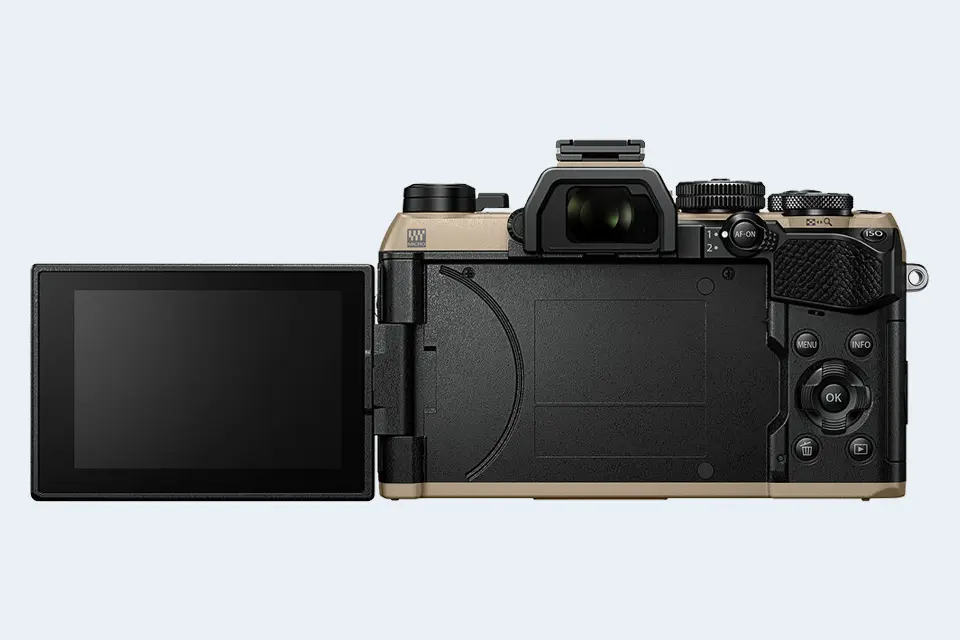
One feature that differentiates the OM-5 II from many older cameras is in-body image stabilization (IBIS). The OM-5 II reduces the risk of handshake-induced blur with all attached lenses, while cameras without IBIS have to rely on optical image stabilization in OIS-equipped lenses to achieve the same effect.
Connection comparison
For some imaging applications, the extent to which a camera can communicate with its environment can be an important aspect in the camera decision process. The table below provides an overview of the connectivity of the OM System OM-5 II and, in particular, the interfaces the cameras (and selected comparators) provide for accessory control and data transfer.
| Camera Model |
Hotshoe Port |
Internal Mic / Speaker |
Microphone Port |
Headphone Port |
HDMI Port |
USB Port |
WiFi Support |
NFC Support |
Bluetooth Support |
||
|---|---|---|---|---|---|---|---|---|---|---|---|
| 1. | OM System OM-5 II | Y | stereo / mono | Y | - | micro | 2.0 | Y | - | Y | |
| 2. | Olympus E-M5 III | Y | stereo / mono | Y | - | micro | 2.0 | Y | - | Y | |
| 3. | Olympus PEN-F | Y | stereo / mono | - | - | micro | 2.0 | Y | - | - | |
| 4. | OM System OM-1 | Y | stereo / mono | Y | Y | micro | 3.0 | Y | - | Y | |
| 5. | OM System OM-1 II | Y | stereo / mono | Y | Y | micro | 3.0 | Y | - | Y | |
| 6. | OM System OM-3 | Y | stereo / mono | Y | Y | micro | 3.0 | Y | - | Y | |
| 7. | OM System OM-5 | Y | stereo / mono | Y | - | micro | 2.0 | Y | - | Y | |
| 8. | Panasonic G90 | Y | stereo / mono | Y | Y | micro | 2.0 | Y | - | Y | |
| 9. | Panasonic GX8 | Y | stereo / mono | Y | - | micro | 2.0 | Y | Y | - | |
| 10. | Sony A6500 | Y | stereo / mono | Y | - | micro | 2.0 | Y | Y | - | |
| 11. | Sony A6600 | Y | stereo / mono | Y | Y | YES | 2.0 | Y | Y | Y |
It is notable that the OM-5 II has a microphone port. Such an external microphone input can help to substantially improve the quality of audio recordings when a good external microphone is used.
Expert reviews
While the specs-based evaluation of cameras is instructive in revealing their potential as photographic tools, it says nothing about, for example, the handling, responsiveness, and overall imaging quality of the OM-5 II in practical situations. User reviews, such as those found at amazon, can sometimes inform about these issues, but such feedback is often incomplete, inconsistent, and biased. This is why expert reviews are important. The table below summarizes the assessments of some of the best known camera review sites (amateurphotographer [AP], cameralabs [CL], digitalcameraworld [DCW], dpreview [DPR], ephotozine [EPZ], photographyblog [PB]).
| Camera Model |
AP score |
CL score |
DCW score |
DPR score |
EPZ score |
PB score |
Camera Launch |
Launch Price |
Street Price |
||
|---|---|---|---|---|---|---|---|---|---|---|---|
| 1. | OM System OM-5 II | .. | .. | .. | .. | .. | .. | Jun 2025 | US$ 1 199 | amazon.com | |
| 2. | Olympus E-M5 III | 5/5 | + | 5/5 | 82/100 | 4.5/5 | 4.5/5 | Oct 2019 | US$ 1 199 | ebay.com | |
| 3. | Olympus PEN-F | .. | .. | 4/5 | 82/100 | 4.5/5 | 5/5 | Jan 2016 | US$ 1 199 | ebay.com | |
| 4. | OM System OM-1 | 5/5 | .. | .. | 87/100 | 5/5 | 4.5/5 | Feb 2022 | US$ 2 199 | ebay.com | |
| 5. | OM System OM-1 II | .. | .. | .. | .. | .. | .. | Jan 2024 | US$ 2 399 | amazon.com | |
| 6. | OM System OM-3 | .. | .. | .. | 86/100 | .. | .. | Feb 2025 | US$ 1 999 | amazon.com | |
| 7. | OM System OM-5 | 5/5 | .. | 4.5/5 | 83/100 | 5/5 | 4.5/5 | Oct 2022 | US$ 1 199 | amazon.com | |
| 8. | Panasonic G90 | 4.5/5 | + | 4.5/5 | 83/100 | 4.5/5 | 4.5/5 | Apr 2019 | US$ 999 | ebay.com | |
| 9. | Panasonic GX8 | 5/5 | + | .. | 82/100 | 4.5/5 | 4.5/5 | Jul 2015 | US$ 1 199 | ebay.com | |
| 10. | Sony A6500 | 5/5 | + + | 3.5/5 | 85/100 | 4.5/5 | 4.5/5 | Oct 2016 | US$ 1 399 | ebay.com | |
| 11. | Sony A6600 | 4/5 | + | 4/5 | 83/100 | 4.5/5 | 4/5 | Aug 2019 | US$ 1 399 | amazon.com | |
| Note: (+ +) highly recommended; (+) recommended; (o) reviewed; (..) not available. | |||||||||||
Care should be taken when interpreting the review scores above, though. The assessments were made in relation to similar cameras of the same technological generation. Hence, a score should always be seen in the context of the camera's market launch date and its price, and comparing ratings of very distinct cameras or ones that are far apart in terms of their release date have little meaning. It should also be noted that some of the review sites have over time altered the way they render their verdicts.
Check OM-5 II price at
amazon.com
OM System OM-5 II FAQ
Below are some additional questions and answers concerning some particular features of the OM-5 II.
What technology is the imaging sensor in the OM System OM-5 II based on?
The camera has a CMOS (Complementary Metal–Oxide–Semiconductor) sensor at its core.
Which image processing chip is used in the OM System OM-5 II to convert the raw signal into an image file and perform noise reduction and image sharpening?
OM System equipped the OM-5 II with the TruePic IX image processor.
What is the ISO sensitivity range of the OM System OM-5 II?
The camera has a native sensitivity range from ISO 200 to ISO 25600, which can be extended to ISO 64-25600.
Does the OM System OM-5 II have a selfie-friendly screen?
Yes, the LCD-screen of the OM-5 II is flexible and can be turned to be front-facing for capturing selfies.
What is the life expectancy of the shutter in the OM System OM-5 II?
OM System does not publish a shutter rating for the OM-5 II. Yet, shutters in comparable cameras from other manufacturers are said to be good for at least 100 000 actuations. It should be noted, though, that this number represents a Mean Time before Failure. The shutter might fail earlier, or it might last longer. Anyway, in order to exhaust an expected shutter life of 100 000 shots over, say, three years, one would have to take about 100 pictures each and every day.
How do I find the shutter count on my OM System OM-5 II?
OM System embeds the number of shutter actuations in hidden menus. You can check the number of shots that your OM-5 II has taken up to now by carefully following the steps described on the OM System OM-5 II shutter count page.
Is completely silent shooting possible with the OM System OM-5 II?
The camera has an electronic shutter option, so that it is indeed feasible to capture images without any shutter noise.
Do I need to purchase an external camera trigger to shoot time-lapse sequences with the OM System OM-5 II?
No, the OM System OM-5 II has an intervalometer built-in, so that low frequency shooting (for example, flower blooming, sunset, moon rise) can be undertaken without the need to purchase a separate external intervalometer and related software.
Is it difficult to use manual focus lenses with the OM System OM-5 II?
The OM-5 II offers focus peaking as a manual focus aid. This feature works by placing a colored highlight on in-focus zones within the image.
Does the OM System OM-5 II feature an autofocus assist light?
Yes, the camera has a lamp built-in that can illuminate the subject and improve autofocus in low-light settings.
What is the fastest shutter speed that can be used with the OM System OM-5 II for flash photography?
The OM-5 II's flash sync speed is 1/250 sec.
Does the OM System OM-5 II support the Ultra High Speed (UHS) bus interface for SD cards?
Yes, the camera can indeed use UHS-II cards (data transfer speed of up to 312 MB/s).
Which battery does the OM System OM-5 II use?
The camera gets its power from the OM System BLS-50 (here at amazon), which is a rechargeable Lithium-Ion power pack.
Camera to camera comparisons
In case you are interested in seeing how this camera compares to another one, just make a corresponding selection in the search boxes below. There is also a set of direct links to comparison reviews that other users of the CAM-parator app explored.
- Canon R100 vs OM System OM-5 II
- Canon R3 vs OM System OM-5 II
- Canon V1 vs OM System OM-5 II
- Fujifilm X-S20 vs OM System OM-5 II
- Leica Q3 vs OM System OM-5 II
- Nikon Z5 vs OM System OM-5 II
- Nikon Z7 II vs OM System OM-5 II
- Nikon Z8 vs OM System OM-5 II
- OM System OM-5 II vs Panasonic G110
- OM System OM-5 II vs Panasonic G85
- OM System OM-5 II vs Sony A7R IIIA
- Olympus E-M10 vs OM System OM-5 II
| Camera Model | OM System OM-5 II | |
|---|---|---|
| Camera Type | Mirrorless system camera | |
| Camera Lens | Micro Four Thirds lenses | |
| Launch Date | June 2025 | |
| Launch Price | USD 1 199 | |
| Sensor Specs | ||
| Sensor Technology | CMOS | |
| Sensor Format | Four Thirds Sensor | |
| Sensor Size | 17.3 x 13.0 mm | |
| Sensor Area | 225 mm2 | |
| Sensor Diagonal | 21.6 mm | |
| Crop Factor | 2.0x | |
| Sensor Resolution | 20.2 Megapixels | |
| Image Resolution | 5 184 x 3 888 pixels | |
| Pixel Pitch | 3.34 μm | |
| Pixel Density | 8.96 MP/cm2 | |
| Moiré control | no AA filter | |
| Movie Capability | 4K/30p Video | |
| ISO Setting | 200 - 25 600 ISO | |
| ISO Boost | 64 - 25 600 ISO | |
| Image Processor | TruePic IX | |
| Screen Specs | ||
| Viewfinder Type | Electronic viewfinder | |
| Viewfinder Field of View | 100% | |
| Viewfinder Magnification | 0.68x | |
| Viewfinder Resolution | 2360k dots | |
| Top-Level Screen | no Top Display | |
| LCD Framing | Live View | |
| LCD Size | 3.0 inch | |
| LCD Resolution | 1040k dots | |
| LCD Attachment | Swivel screen | |
| V-logging Friendliness | Front-flip possible | |
| Touch Input | Touchscreen | |
| Shooting Specs | ||
| Focus System | On-Sensor Phase-detect | |
| Manual Focusing Aid | Focus Peaking | |
| Maximum Shutter Speed | 1/8000s | |
| Continuous Shooting | 10 shutter flaps/s | |
| Shutter Life Expectancy | 100 000 actuations | |
| Silent Shooting | Electronic Shutter | |
| Time Lapse Photography | Intervalometer Built-in | |
| Image Stabilization | In-body stabilization | |
| Fill Flash | no On-Board Flash | |
| Storage Medium | SDXC cards | |
| Single or Dual Card Slots | Single card slot | |
| UHS card support | UHS-II | |
| Connectivity Specs | ||
| External Flash | Hotshoe | |
| USB Connector | USB 2.0 | |
| HDMI Port | micro HDMI | |
| Microphone Port | External MIC port | |
| Wifi Support | Wifi built-in | |
| Bluetooth Support | Bluetooth built-in | |
| Body Specs | ||
| Environmental Sealing | Weathersealed body | |
| Battery Type | OM System BLS-50 power pack | |
| Battery Life (CIPA) | 310 shots per charge | |
| In-Camera Charging | USB charging | |
| Body Dimensions |
125 x 85 x 50 mm (4.9 x 3.3 x 2.0 in) |
|
| Camera Weight | 414 g (14.6 oz) | |
Did you notice an error on this page? If so, please get in touch, so that we can correct the information.
You are here: Home » CAM-parator » OM System OM-5 II Review