Camera maker Olympus and sensor manufacturer Kodak created the Four Thirds standard as a means
of providing an imaging system that was designed from the ground
up for digital photography. In particular, tele-centric lens design
was intended to explicitly accommodate the
requirements of digital sensors for orthogonal light reception. Other objectives were interoperability within the open standard, as well as
light weight and compact equipment size.
As a side effect of the launch of the FT-system in 2003, a whole new set of
terms and acronyms was born. Then in 2008 when Panasonic released the G1 as the first
Micro Four Thirds camera, the system-specific terminology became
even more complex, so that it now ranges from Anti-Shock to
ZERO-Coating. The listings and explanations below aim to
cut through this jargon and help users to better understand and appreciate their camera and lens system.
If you think that there is an important entry missing, please let me know. And if you can already provide a
tentative definition, that would be even better. Just drop me a note by email
and I will add the new term to the listing. Thanks in advance for your help!
2x2 Control Dial on an E-M1
The 2x control dial is a lever on the back of selected Olympus camera that changes the functionality of the front and rear wheels.
The handling feature was first introduced on the PEN E-P5 and
subsequently also implemented on some OM-D models.
The locking lever, which can be moved by thumb between positions 1 and 2,
lets photographers switch between two customizable functions
each of the front and rear dials. These wheels can then be used to quickly
adjust a total of four different camera settings, such as aperture, exposure compensation, ISO,
and white balance. The assigned settings control will normally vary by PASM shooting mode. The 2x2 Control Dial represents a very convenient way of
quickly operating a camera, without the need to take the eye off the viewfinder or to
delve into the menu.
43rumors.com:
43rumors.com is a website dedicated to reporting news
on Four Thirds and Micro Four Thirds cameras, lenses and accessories. It started out in
March 2009 with the aim of collecting information on FT and MFT system equipment from official
and inofficial internet sources. In particular, 43rumors relies on a network of collaborators
to publish information on new products before these are formally released. Rumors are rated
according to the past track record and credibility of the sources on a five-point scale from
"probably fake" to "almost certainly true". 43rumors also reports on web-based reviews of
cameras and lenses, as well as on commercial promotions and deals. The site is operated by
Andrea Pizzini, an Italian-born film maker, photographer and digital camera enthusiast,
who lives near Antwerp/Belgium. The site depends on affiliate commissions and banner
advertisements for its income, but is not associated with any photographic equipment
manufacturer. Over time, 43rumors has grown into one of the most popular photography
news sites on the web, with an audience (according to estimates by similarweb.com)
of more than 1.2 million user sessions per month.
4K Photo:
4K Photo is an operating mode on selected Panasonic mFT cameras that
lets photographers extract single frames with a resolution of 8 MP from 4K recordings.
4K Photo is different from simply grabbing a simple image
from video footing by making it possible to select a still
image-friendly aspect ratio, choosing aperture and shutter speed
values optimized for still capture, and providing full
EXIF information for the individual image. The operating mode
is particularly useful for capturing the "decisive moment" of
fast-moving subjects.
6K Photo:
Similar to 4K Photo, 6K photo makes it possible to extract
still image frames from high resolution video footage. The operating
mode was introduced by Panasonic in 2017 with the GH5. 6K Photo frames have a
resolution of about 18 megapixel.
A
Anti-Shock:
Anti-Shock mode on an E-P5
Anti-Shock is an Olympus term, which was originally used for a mirror
lock-up mechanism to reduce vibration from the mirror swing on Four-Thirds DSLR. On mirrorless m43 cameras,
the term refers to a
delay between the shutter closing and it opening,
allowing for time for the vibrations caused by the shutter movement
to die out and, thus,
eliminating the risk of image blur. Selected cameras also
feature a "0 Sec Anti-Shock" setting, whereby the camera uses its
electronic rather than its mechanical shutter for first curtain operation at certain shutter speeds.
Electronic shutters do not rely on any moving parts, whose deceleration
could cause vibrations. Hence, electronic shutters are not subject to the adverse effects of
shutter shock.
B
Body-cap lens:
Body-cap lenses are thin, low prices lenses, first released by Olympus in 2012 in the form of the
15mm f/8 (and later joined by the 9mm f/8 Fisheye). They are supposed to replace a body cap, while making quick snapshots possible.
The body-cap lenses have a fixed aperture, are manual focus only, and do not communicate with
the camera in any way. Their optical design is simpler than that of other mFT lenses, and Olympus
refrained from providing them with the M.Zuiko designation.
C
Conversion lens:
Conversion lenses have been released by Olympus and Panasonic as low-cost alternatives to their
interchangeable lens lineup. These light-weight lens supplements attach to the front end of the standard camera lens
via the filter thread and make it possible to achieve fisheye effects or enhance the wide-angle, tele-photo, or
macro photography capability of the standard lens. Olympus and Panasonic have been promoting their conversion
lenses particularly in relation to their 14-42mm kit zooms, but the add-on lenses can also be used with some other optics.
D
Decoration ring:
Decoration rings are available as accessories for certain Olympus mFT lenses. They
attach to the lens via the bayonets of the lens hood or tripod mount adapter, when the
latter are not in use. Decoration rings provide a smoother appearance to the lens and, in some
cases, make it possible to add a color accent. Moreover, decoration rings
that cover the studs of the tripod mount adapter, such as the
Olympus DR-66, can help to avoid irritation when shooting hand-held.
DFD – Depth from Defocus:
Depth from Defocus is a Panasonic-technology, first introduced in the GH4, to
improve autofocus tracking of moving subjects.
DFD calculates the direction and the amount to move the focus lens
based on two images captured with different depth of field in connection
with knowledge of the bokeh characteristics of the attached lens. This information
makes it possible to jump to the new focus point in a single movement, instead
of the gradual and slower "trial and error" method of standard contrast-detect AF systems.
However, the technology only works with Panasonic lenses,
as DFD is not part of the Four Thirds standard.
DMC – Digital Media Camera:
DMC is an abbreviation that Panasonic uses as part of its product code for
all Lumix cameras. Apart from stating that the camera
uses digital storage media, the acronym does not carry any technical or differentiating meaning.
Other consumer products from Panasonic, such as televisions or electric shavers, also carry a
"family acronym" in their product name.
Dual IS (Image Stabilization):
Dual-IS is a handshake correction system introduced by Panasonic with
the Lumix GX8 that combines lens-based OIS technology with sensor-shift, body-based stabilization.
According to Panasonic, their O.I.S. lenses correct for two axes of motion,
while their sensor shift mechanism compensates for four. The
combination of the two systems yields stabilization across
all five axes of motion. Panasonic claims that Dual-IS on the GX8 is 3.5x better
at wide-angle and 1.5x better at telephoto compared with the stabilization provided in the GX7.
Most lenses with Mega-OIS or
Power-OIS that were released
prior to the GX8 can be updated to support the Dual-IS
functionality via firmware (the exceptions are the 14-45mm, 45-200mm, and 100-300mm).
An improved version (Dual IS 2) was introduced with the Panasonic G80/G85. It
combines in-body stabilization across five axis with two axis of stabilization
provided by Lumix OIS lenses. Selected lenses can by upgraded via firmware to
take advantage of the more effective hand-shake correction of Dual-IS 2.
Dual VCM (Voice Coil Motor):
Dual-VCM is a focusing system introduced by Olympus with
its 40-150mm f/2.8 PRO zoom. It is based on the separation
of the focusing lens elements into two VCM groups that are
simultaneously controlled by their own linear-drive motor to produce extremely quick, quiet, and precise focusing.
Voice coil motor systems are based on rectilinear motion, with the coil being the only moving part.
This makes it possible to achieve high-speed autofocus and accurate positioning with virtually no sound.
Dual VCM represents an evolution of the Movie and Still Compatible mechanism in earlier
Olympus lenses.
E
Equivalent focal length:
Equivalent focal length is a measure that indicates the corresponding angle of view of a lens and sensor size combination,
expressed in terms of the traditional 35mm film format. A given lens mounted on a camera with a small sensor
will generate a narrower angle of view than the same lens used in combination with a full frame
35mm format camera. Hence, in order to get a similar angle of view, the photographer has to use
different focal lengths on small sensor and full frame sensor cameras.
The diagonal of the Four Thirds sensor is half as
long as the diagonal of a full frame 35mm sensor, giving rise to a format factor or 2. The
equivalent focal length of a (m)FT lens, thus, is half as long as a
given full frame lens in order to yield the same angle of view. For example, a 25mm lens on a
Micro Four Thirds camera has the same angle of view
as a 50mm lens on full frame. A secondary dimension of equivalence concerns depth of field.
As its equivalent focal length is shorter, mFT provides deeper DOF. Equivalent depth of field
can be calculated by multiplying the aperture value used on a small sensor camera by the format factor.
For example, a 1.4/25mm lens on mFT is equivalent in both focal length and DOF to a 2.8/50mm lens
on 35mm full frame.
ESP – Electro Selective Patterns:
ESP is a Olympus-specific metering method that meters the brightness of the center and
the surrounding areas separately. In recent cameras, ESP meters exposure in
more than 300 areas of the frame and optimizes exposure accordingly. For example,
metering gives priority to any faces that are being detected.
Olympus recommends the use of ESP for general use.
EVOLT:
Evolt is a marketing designation for
non-professional DSLR cameras that was used by Olympus in North America up to
2007. The E-410 and E-510 were the last cameras marketed as EVOLTs.
There had been three EVOLTs earlier (E-330, E-500, E-300), bringing the total to
five (the E-400 was only sold in Europe).
F
FAST (Frequency Acceleration Sensor Technology):
FAST is a Olympus autofocus tracking system introduced with the PEN E-P3.
The FAST chip reads image data off a large number of separate focus points spread
over nearly the entire sensor. This is achieved at a speed of 240 frames-per-second,
which leads to shortened image blackout in the viewfinder and enables photographers
to better track fast action.
Focus Stop Buttons:
Focus Stops on ZD 150mm
Focus Stop Buttons are controls on selected Olympus Four Thirds lenses to temporarily deactivate autofocus
operation, so as to maintain focus at the point where the button was pressed. The Focus
Stop Buttons, thus, make it possible to
prevent the auto-focus system in C-AF mode from adjusting to foreground movement, after correct focus on the primary subject has been achieved.
Three Super High Grade optics (Olympus ZD 35-100mm, ZD 90-250mm,
and ZD 150mm) are equipped around the front end of the lens with
four Focus Stop Buttons each. All of these buttons have the same effect.
The (single) L-Fn button on some Olympus mFT lenses can perform the
same functionality, if set in the camera menu to AF-stop (which is its default).
FP-TTL – Focal Plane-Through The Lens:
FP-TTL is an Olympus flash mode that makes it possible to use flash at
high shutter speed, notably for fill-in portraits in bright sunlight.
The flash fires multiple pulses in coordination with the
movement of the shutter, such that the entire focal plane
gets illuminated, even as the shutter speed exceeds the camera's
sync speed.
Similar
features at other manufacturers are often labeled as High
Speed Synchronization.
FT – Four Thirds:
Origin of Four Thirds[dpnow.com]
Four-Thirds is an open standard for a digital camera system
that is centered on a sensor, whose size corresponds to
the imaging area of a video camera tube of 4/3 inch diameter. The
size of the video tube inspired the name for the FT standard. The 18 mm x
13.5 mm sensor used in Four-Thirds and Micro-Four-Thirds cameras happens to offer an aspect ratio of 4:3. Its
diagonal (22.3mm) is half the size of a 35mm full frame image receptor, giving
rise to a format factor of 2. The Four-Thirds lens mount has a flange focal distance of 38.67mm
and is about twice as large as the diameter of the image circle,
which makes it possible to produce lenses for the system that are telecentric
and offer even contrast and sharpness across the entire image frame.
Moreover, the standardized mount creates the possibility for photographers to
freely combine interchangeable lenses and cameras from different manufacturers that
adhere to the standard.
Four-thirds.org:
Four-thirds.org is
the official website of the Four Thirds consortium. The site is
maintained by Olympus, but also features information on products from other consortium
members, such as Blackmagicdesign, Cosina, Kowa, Panasonic, Sigma, and Tamron. The content on four-thirds.org
includes information on the history of the system, catalogs of past and present
cameras and lenses, and a matching tool that makes it possible to visualize different camera and lens
combinations.
G
Gradation:
Gradation is a function available in Olympus camera menus to affect the brightness and contrast
of the processed image. By choosing a particular setting, the photographer can create or reinforce a certain
mood in an image. The gradation tool can be activated either before a shot or ex-post during in-camera raw editing.
H
HD Video Support:
HD Video Support is a feature of many Panasonic mFT lenses implying quick and
quiet autofocus operation and smooth aperture change during
movie recording. As a result, continuous AF tracking is available
during video capture, no operating noise is
being picked up on the audio track, and no sudden jumps in exposure occur
when the aperture changes. Similar to the
MSC mechanism in Olympus lenses, Lumix optics with HD Video Support
use an inner focus, direct-drive, linear motor for focusing action.
Hidden Menus:
Hidden menus are sections of camera memory that contain information for
Olympus and Panasonic service personnel, such as errors that
the camera's operating system has encountered.
One piece of very useful information that the hidden menus reveal is the
number of shutter actuations the camera has performed so far. Separate instructions on how
to access this shutter count information are available
for Four Thirds,
Olympus mFT and
Panasonic mFT cameras.
More information on how to interpret the hidden menus is contained
in the camera's service manual (see, for example, the respective
Panasonic pdf downloads).
HG – High Grade:
High Grade is a designation of a
dust and splash proof series of Olympus FT lenses aimed at
enthusiast photographers. The set comprises 6 zooms and 4 prime
lenses. The 2.8-4/12-60mm, 2.8-3.5/50-200mm and the 2/50mm Macro
were particularly appreciated by FT-shooters for their very
good imaging performance, while being relatively compact
and accessibly priced. At times, these three HG optics were
referred to as the "Holy Trinity of Four Thirds". –
In some countries, the lens series was called "Pro Grade" instead of HG.
Hybrid-OIS (Optical Image Stabilization):
Hybrid-OIS is a system to reduce the adverse consequences of camera shake
during movie recording, introduced by Panasonic initially in some
of its camcorders and then also in its cameras (first in the Lumix GX8). Hybrid-OIS provides
video stabilization across all five axis of movement. This 5-axis
stabilization is achieved by combining lens-based OIS, which can
adjust for movement along up to four axis (horizontal, vertical, yaw and pitch), with electronic
stabilization, which in the case of Hybrid-OIS corrects for movement around
the lens axis ("roll").
I
IBIS – In-Body Image Stabilization:
Olympus 5-axis IBIS
IBIS is a system to reduce adverse impacts of camera shake by shifting
the sensor in such a way as to counteract the motion of the camera.
Olympus introduced image stabilization with their E-510 Four-Thirds camera,
employing a system built around their Supersonic Wave Drive, and
Panasonic first included IBIS in their GX7. The early implementations
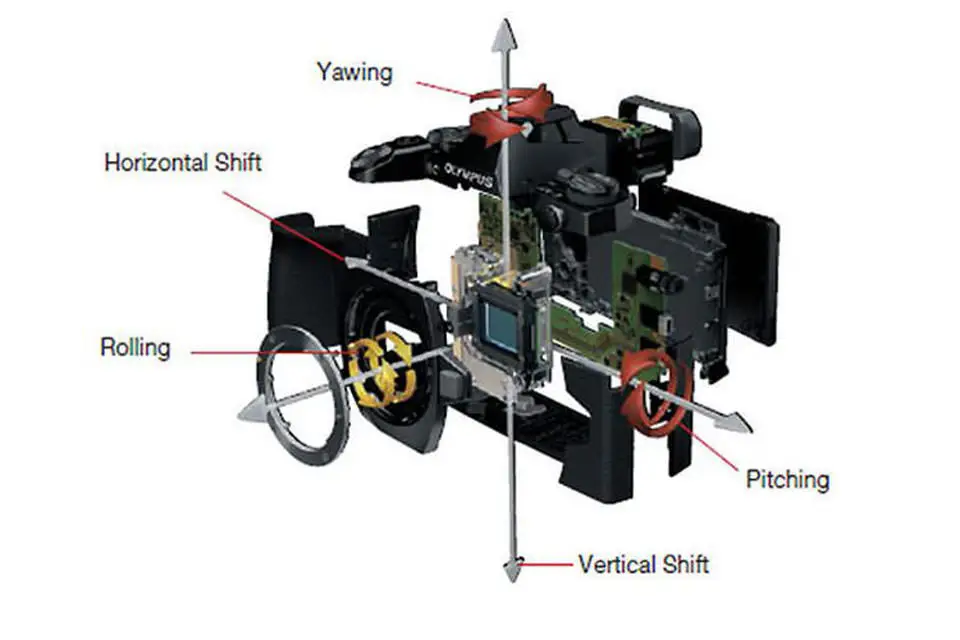
of IBIS shift the sensor around two axis: pitch and yaw. In 2013,
Olympus introduced the E-M5, which features 5-axis IBIS,
counteracting movement in terms of horizontal shift,
vertical shift, rotary motion, as well as pitch and yaw. The system
is highly effective and can make it possible to shoot blur-free images handheld at
shutter speeds that are 4-5 times longer than would otherwise be possible.
IBIS can, of course, only counteract camera shake-related movement, but
not any movement in the imaging subject itself.
Imager AF:
Imager AF is an autofocus technology that uses
the imaging sensor to achieve focus with Olympus mFT cameras
and lenses. It is also available in Olympus FT cameras
and lenses released since 2008. The Imager AF technology uses contrast detection
to secure focus.
J
Jitter problem:
Jittering has been observed by several users when shooting video handheld with selected Panasonic
lenses using OIS. Apparently, the image stabilization system generates micro vibrations that can become annoying distractions in movie footage
(see this Youtube video, for example).
The 14-140mm II and, to a lesser extent, the 35-100mm seem to be affected.
The jitter issue is limited to video, though, and does not cause any problems during still photography.
Joint Update Service:
The Joint Update Service
for lens firmware is a common project of Olympus, Panasonic, Sigma, and Tamron.
This initiative lets photographers use any FT or mFT camera to update their lens by connecting to the
internet and downloading the latest firmware. Hence, it is not necessary to have a camera from the same
manufacturer as the lens to update the lens-firmware.
K
Kodak:
Eastman Kodak was a founding member of the Four Thirds consortium and in 2003 supplied the sensor
for the first FT camera, the Olympus E-1. Kodak had been one of the pioneers of digital imaging and its
E-1 sensor was highly appreciated for its truthful color rendition. However, the company was slow to adjust to the rapid decline in its core film
business and filed for bankruptcy in 2012. The Kodak
brand name for digital cameras was subsequently licenced to JK Imaging. The latter joined
the Micro Four Thirds System Standard Group, and in January 2013 launched its first MFT-camera, the
Kodak Pixpro S1.
L
L-Fn button:
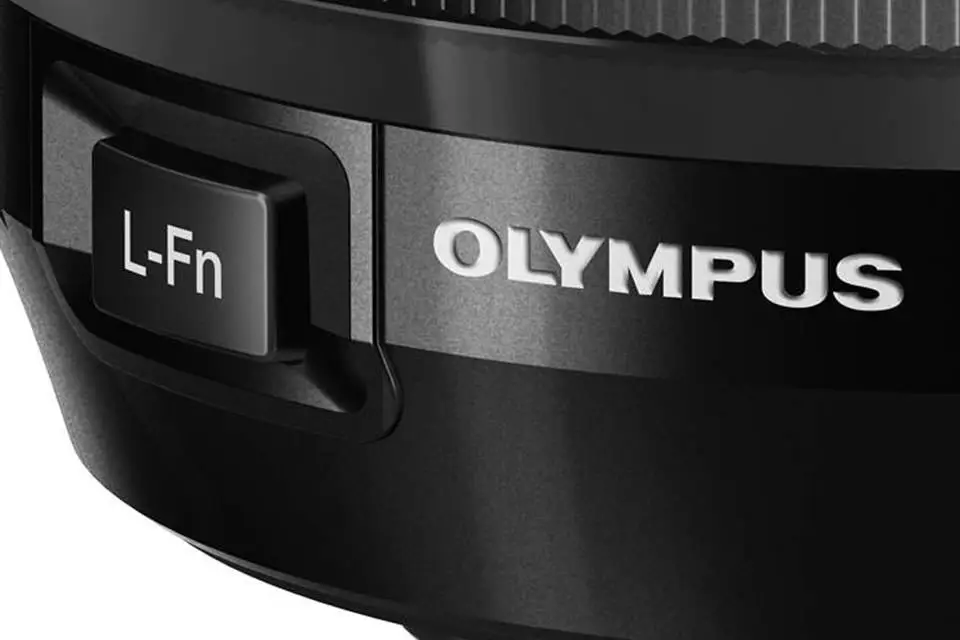
The L-Fn button
The L-Fn button is a control on selected Olympus mFT lenses that can be
configured through the camera's setup menu.
Once the menu option has been assigned,
pressing the L-Fn button activates the preselected menu option.
Hence, the button acts as a shortcut to the selected imaging feature. The default function of
the L-Fn button is AF Stop, which temporarily suspends continuous autofocus when an object suddenly
appears in front of the lens. Another popular choice is to use the button to activate the digital teleconverter,
so as to enlarge the center portion of the image.
The menu option selected for the L-Fn button does not have to be any specific lens
function, though, but can equally alter general camera settings,
such as white balance or the use of the HDR function.
Leica D/DG:
Leica Summilux 25mm (mFT & FT)[omuser.com]
Leica D and DG are designations for a series of premium lenses from Panasonic.
All Four-Thirds lenses sold by Panasonic (three zooms and one prime) were Leica D optics, and
several Leica DG lenses have over time become available for Micro Four Thirds. Every D or DG lens
carries a Leica lens-speed designation, like Nocticron,
Summilux, or Elmarit. It is understood
that the lenses are designed and produced by Panasonic, but submitted for approval to Leica with
respect to their optical characteristics and manufacturing tolerances.
Hence, Panasonic-Leica lenses are required to meet a set of demanding quality standards
established by the German company, but are otherwise the
result of Japanese optical manufacturing excellence. The close cooperation between the
two companies on the D/DG lenses has also had a positive impact on the technology
and quality in other camera and lens system areas of the partners.
LUMIX:
Lumix is the brand name used by Panasonic
for its cameras and lenses. The company claims that the
term
Lumix
is derived from a combination of "luminance" and "mix",
with the latter referring to the joining of Leica's optical know-how
with Panasonic's expertise in electronics. This collaboration is
said to have created a quality in imaging that none of the partners
could have achieved on their own.
M
M.ZD – Micro Zuiko Digital:
M.ZD is the designation of Olympus Micro Four Thirds-lenses. The company categorizes its
optics into three series: M.Zuiko (standard) is a set of lenses that features compact and lightweight construction,
M.Zuiko Premium consists of an array of fast, elegantly designed primes, and
M.Zuiko PRO is a range of weathersealed, fixed maximum aperture lenses dedicated to professionals.
Mega-OIS (Optical Image Stabilization):
Mega-OIS is a lens-based system to reduce the adverse
impacts of camera shake, used by Panasonic and Leica in some
FT and mFT lenses. The feature was introduced with the very first
FT lens from Panasonic, the Panasonic-Leica 14-50mm f/2.8-3.5.
In practice, Mega-OIS provides a stabilization benefit of about
one stop, so that an image that could be taken blur-free at 1/15 sec without
stabilization, could be taken at 1/8 sec if Mega-OIS is turned on.
The subsequently released Power-OIS system
is more effective, particularly at low
shake frequencies.
mFT (or m43) – Micro-Four-Thirds:
The FT and mFT mounts compared[panasonic]
Micro-Four-Thirds is an imaging
system standard that is based on the same sensor size as
Four
Thirds, but abandoned strict telecentricity in lens design in favor of
a combination of micro-lenses and in-camera software correction of image faults.
Moreover, mFT uses a shorter flange-to-focal-plane distance (19.25mm vs 38.67mm on FT), a slightly
smaller lens mount diameter and two additional electrical contacts
for high-speed data transmission. As a mirrorless system, mFT
does not need to accommodate a mirror box in the optical path, so that
the camera bodies can be build slimmer than those of DSLRs. Further
reductions in size for both cameras and lenses are made possible with the
narrower mount and the shorter focal-plane distance. Finally, the
increase in the number of electrical contacts in the mount from 9 to 11
facilitates information transfer between camera and lens for data-intensive
video shooting. Micro-Four-Thirds is an open standard, and the number of
participating companies has increased substantially over time.
MSC – Movie and Still Compatible:
MSC Mechanism[olympus]
MSC is a mechanism in most Olympus Micro Four Thirds lenses to enable fast and quiet autofocus during
still image capture and movie
shooting.
The Movie and Still Compatible module is part of the inner focusing system that adjusts
focus by optimally displacing only one or a few lightweight lens elements.
The focusing element is moved alongside a metallic shaft using a precision-finished feed screw.
There are no gears involved, which in traditional AF systems cause operating noise
that is particularly detrimental during video capture with an in-camera microphone.
MSC, thus, enables smooth autofocusing with high speed and ultra-low noise for
both still and movie shooting. Lenses made by Panasonic that are labelled to provide
HD Video Support have a similar
design and offer the same functionality of fast and silent focusing operation.
N
NSC – Nano surface coating:
Nano surface coating is a coating technology used by Panasonic on newer mFT lenses to reduce
ghosting and flare. It consists of an extra-low refractive index
coating with nano-sized structure. Panasonic claims
a dramatic reduction in reflections across the entire visual light range.
O
OM-D:
OM-D is the designation of Olympus mFT cameras with an integrated, centrally-located viewfinder.
The design of the OM-D cameras with a large, angular viewfinder housing makes
reference to the company's analog OM Series, which started with the OM-1 back in 1973.
Three lines of OM-D's have been launched that differ in features and size: The (relatively)
large E-M1 is weathersealed and features a sensor with phase-detect pixels, so that it
can autofocus legacy FT lenses as quickly as an FT camera. The mid-level E-M5 is
equally sealed against dust and moisture, but relies exclusively on contrast-detection for autofocus. Finally,
the compact E-M10 also uses contract-detect autofocus, but does not feature any
weathersealing.
P
PEN:
PEN is the brand name for Olympus
rangefinder-style mFT cameras, reminiscent of the
half-format cameras marketed by the company from 1959
to the early 1980s. The PENs feature a stylish metal finish for their
small-sized bodies. In addition to the main line of
E-P cameras, Olympus also released a E-PL (PEN Lite) range and a
E-PM (PEN Mini) series, which are more compact and
have a simplified interface without control dials.
Pixel mapping:
Pixel mapping is an Olympus function to ignore dead
or stuck pixels. When a user launches the pixel mapping function
through the camera's menu, a firmware algorithm searches for
individual photodiodes that are dead (always black) or stuck (always white).
If such pixels are found, an interpolation procedure explores the pixels
around the dead or stuck pixel, maps their locations, and inserts estimates
for the data the malfunctioning pixel should be delivering.
Post Focus:
Post Focus is a feature on selected 4K-capable cameras from Panasonic that lets
photographers chose the point of focus after an image has been taken.
Post Focus makes use of Panasonic's DFD technology, while
shooting sequences of 4K-video at 30p. The feature works by continually adjusting the focus point in
each of the 4K frames. The photographer
can then ex-post select the area on the image that should be in focus, and
the camera will compare the frames it captured before putting forward
the one in which that chosen area is best-defined.
Power-OIS (Optical Image Stabilization):
Power and Mega-OIS compared[panasonic]
Power-OIS is a lens-based system to reduce the adverse
impacts of camera shake, used by Panasonic in some mFT
lenses. Power-OIS is more effective at suppressing lower hand-shake
frequencies than the earlier released Mega-OIS.
In particular, Panasonic states that Power-OIS is very good at compensating for vibration
caused when pressing the shutter button or when shooting in low light
with slow shutter speeds. In
practical tests of the Lumix 1.7/42.5mm Power-OIS,
the system delivers
a benefit of about 3 stops in shake compensation, so that a blur-free image taken
hand-held at 1/80 sec without stabilization, could be taken at
1/10 sec if Power-OIS is activated. Lenses that have Power-OIS can
be updated via firmware to support Dual-IS
in more recent Lumix cameras that combines the in-lens stabilization with in-camera sensor stabilization.
Pro Capture:
Pro Capture is a shooting mode introduced by Olympus with the OMD E-M1 ii.
It is designed to grab the decisive moment in fast moving action, such as taking a picture of
an arrow piercing through a row of water-filled balloons. When in Pro Capture mode,
the camera will continuously buffer full resolution images once the shutter button
is half pressed, and on full shutter release will save the image taken plus the 14 previous consecutive frames.
Q
Quick-AF:
Quick-AF is a function on selected Panasonic cameras that speeds up the focusing process. With the
Quick-AF mode enabled, the camera acquires focus on the object in front of the lens even without
the photographer half-pressing the shutter button. Hence, the object is always in focus and the camera
is ready to take the shot when the decisive moment arrives. On the downside, Quick-AF runs down the battery faster,
as the camera is permanently re-focusing.
R
Roadmap:
Roadmaps of upcoming lens releases have been used by both Olympus and Panasonic during the early stages of
the Four Thirds and Micro Four Thirds systems. These outlines of future lens releases played a critical role
in informing early adopters of the path of development for the lens catalog. Being new mounts without any
fully compatible legacy lenses, the roadmaps helped to re-assure users that a broad selection of optics would become
available in the near term and that it was, thus, worthwhile to buy into the system.
S
SCP – Super Control Panel:
The Super Control Panel is an easy access grid that makes it possible to quickly change
core settings on Olympus cameras. It is displayed by default
on the camera’s panel display when using the viewfinder to preview the image for shooting,
but can be customized to also show when using live view shooting.
The Super Control Panel provides one touch access to functions like ISO, white balance,
metering, sequential shooting, self timer, and focus mode.
SG – Standard Grade:
Standard Grade is the designation
of an Olympus FT lens series developed for cost-performance
and portability. Many of the lenses in this series were sold as
part of camera/lens-kits. This includes the ZD 14-42mm f/3.5-5.6 and
ZD 40-150mm f/4-5.6 lenses, which at the time of their launch were the world's smallest and lightest DSLR zooms
for their respective focal length range. Unlike the HG and SHG optics,
SG lenses are not weathersealed.
SHG – Super High Grade:
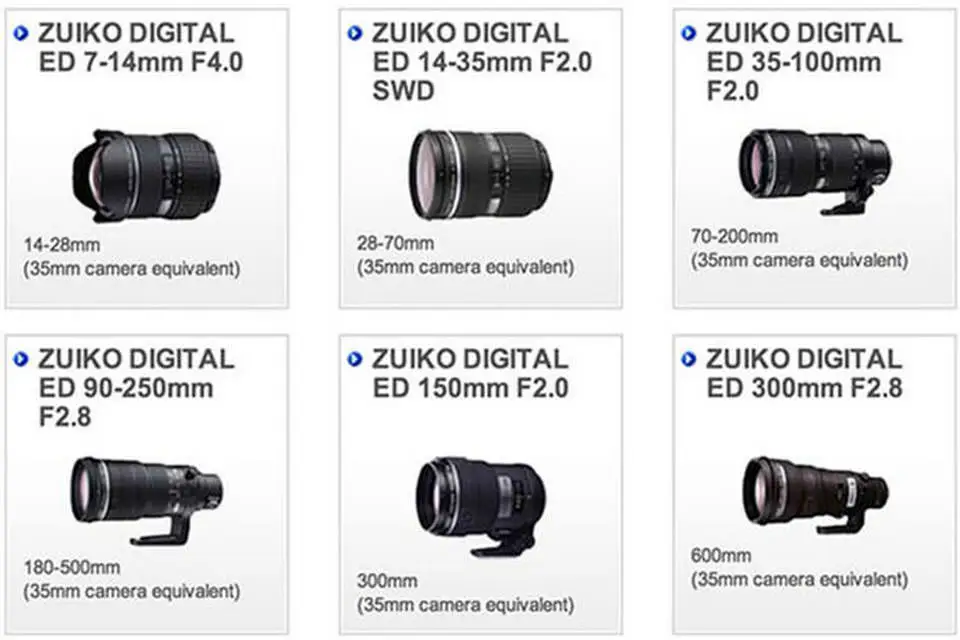
The six SHG lenses[olympus]
SHG is the designation
of a fixed aperture, dust and splash proof series of Olympus
Four-Thirds lenses that offers exceptional optical quality and is
aimed at professional photographers. The set
consists of four zooms, covering focal lengths from
super wide-angle to super-tele, and two super-tele primes.
The 150 f/2 and 300mm f/2.8 (nicknamed "Little Tuna
and "Big Tuna" by Olympus enthusiasts) have particularly high resolving power and provide
excellent sharpness wide-open, even when used in combination with
the EC-20 2x teleconverter. The 14-35mm and 35-100mm SHG zooms have a
maximum aperture opening of f/2, which at the time of release were the
world's fastest zoom lenses for any interchangeable camera system.
All SHG-lenses
carry a platinum line on the lens barrel as a mark of distinction. –
In some countries, the set of lenses is called
"Super-Pro" instead of SHG.
Shutter Shock:
Shutter Shock is image blur caused by shutter vibration in mirrorless cameras.
At certain shutter speeds – typically 1/20s to 1/200s –
the movement of the shutter causes the camera body to vibrate, which leads
to image degradation. The problem can be avoided by using the
electronic shutter (if available) or the 0 sec Anti-Shock mode
on newer Olympus cameras.
Simulated Optical Viewfinder (S-OVF):
Backlit scene in S-OVF[olympus]
Simulated OVF is a setting on selected Olympus cameras that
enables a view through the electronic viewfinder that is similar to what is shown in an optical viewfinder.
In particular, S-OVF expands the dynamic range in the EVF, enhances shadow detail, and suppresses highlight blowouts.
Hence, it becomes easier to frame and focus in backlit conditions, and the unprocessed display
may help to better assess the shooting atmosphere in a dark environment.
On the other hand, exposure compensation and white balance are not reflected in the display of the S-OVF.
All data overlay options can still be displayed, but only those settings also typically found
in optical viewfinders (shutter speed, aperture, ISO, and exposure meter scale) are active. The process of toggling the S-OVF
on and off can be assigned to one of the function buttons for quick and convenient selection.
SSWF – Supersonic Wave Filter:
Sensor assembly with SSWF[euyoung.net]
SSWF is a mechanism to protect the imaging sensor of
(Micro) Four Thirds cameras from dust by vibrating
a transparent filter that is located between the camera’s shutter and the sensor at an ultrahigh
frequency of over 30,000 moves per second.
The "dust shaker" consists of a circular glass panel, encompassed with a piezoelectric ceramic ring.
The removed dust is retained in an adhesive retention area built in beneath the SSWF.
Olympus included the SSWF-mechanism with its very first
DSLR – the E-1 – which meant that
Four Thirds users rarely had to undertake the dreaded
task of cleaning dust particles off the sensor. Over time, other
manufacturers caught on and developed similar
in-camera dust removal systems, so that the technology has become
a virtually universal feature on modern digital cameras.
SWD – Supersonic Wave Drive:
SWD is a fast
and quiet autofocus motor used in some Olympus lenses. SWD
uses an electric motor powered by ultrasonic vibration. The
technology is similar to Panasonic's XSM autofocus system.
Olympus claimed in 2007 that the new ZD 12-60mm F2.8-4.0 SWD lens
then provided the world's fastest autofocus speed when mounted on an E-3.
T
Tatsuno Quality:
Tatsuno Quality is a quality standard for Olympus
lenses named after the plant where the lens
standards are conceived and formulated. Tatsuno is a
city of about 20,000 inhabitants in the Nagano prefecture.
This region, which is about 3 hours by car from Tokio, has a long tradition of precision engineering.
Tele-centric Lens:
Telecentric lens design[olympus]
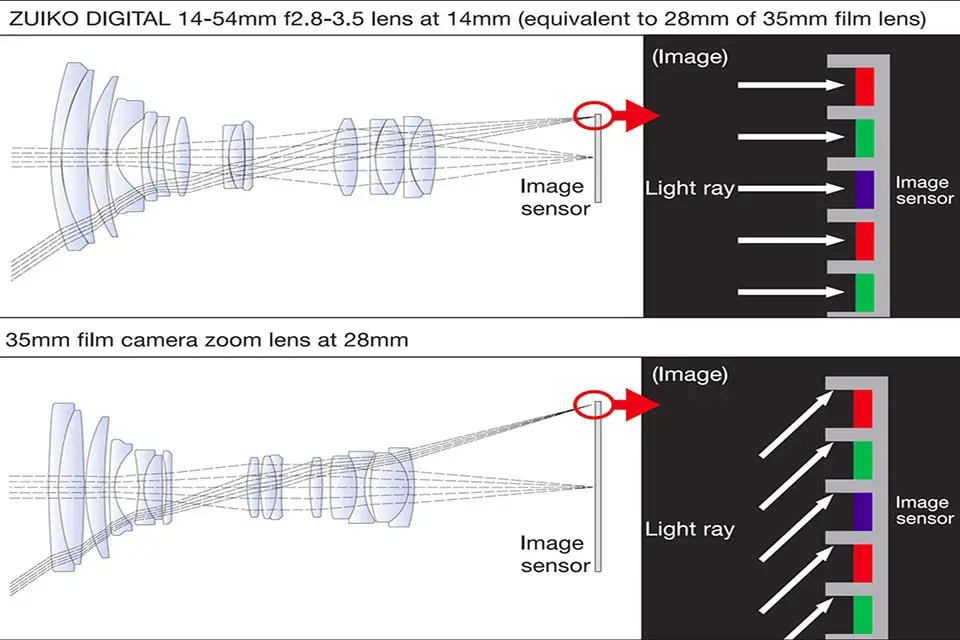
A tele-centric lens is an optic that produces an image
from light rays that travel perpendicularly to the surface
of the image sensor. Telecentric lenses eliminate the parallax error that occurs with standard
lenses by having a constant, non-angular field of view. They always have the
same field of view, irrespective of the focusing distance.
Telecentric lenses offer high
contrast and sharpness from corner to corner, and suffer less
from chromatic aberration and shading of peripheral areas than traditional 35mm film lenses.
The improvements in image quality are particularly pronounced for
wide-angle lenses.
Telecentricity is one of the core aspects of
the Four Thirds system, and all native
Four Thirds optics are based on this
approach to lens design. Telecentric design is
facilitated through the relatively large diameter of the
FT-mount, which gives engineers the space
to implement corresponding optical structures.
TruePic:
TruePic is the designation of the image
processing engine used by Olympus in FT and mFT cameras. This
digital system processor translates the information from the Bayer sensor
into a color picture and performs noise reduction and image sharpening.
Subsequent versions of the engine have offered improved imaging fidelity and operating speed.
Panasonic cameras use the Venus engine.
U
Updater:
The Digital Camera Updater is a freeware for Mac or PC that is used to update the firmware
of Olympus cameras, lenses and accessories or to add display languages. It is available as
a standalone application or integrated into the Olympus Viewer package. The Updater supports
all FT and mFT cameras, except for the Olympus E-1.
V
Venus:
Venus is the name of the image processing engine used by Panasonic in its Lumix cameras.
Similar to Olympus' TruePic, this set of microchips processes the signal from
the imaging sensor to generate the colored image, reduce noise, and
sharpen the final image. Over time, progressively better performing
versions have been implemented in FT and mFT cameras.
W
Wrotniak.net:
Wrotniak.net is a website that publishes news, information
and reviews of Four Thirds and Micro Four Thirds cameras, lenses, and accessories. The focus of the site, which is maintained by Andrej Wrotniak,
is on Olympus equipment. Wrotniak.net is particularly well known for its camera cheat sheets that guide Olympus
users through the often complex camera menus and explain the various configuration parameters.
X
X-lens:
X-lens is the designation of a series of
Panasonic mFT premium lenses that feature power-OIS,
nano surface
coating, and special-glass lens elements. The group comprises the constant
aperture f/2.8 zooms (12-35mm and 35-100mm), as well as the two 14-24mm
and 45-175mm powerzooms. All X-lenses are suitable for
High-Definition video recording.
XSM – Extra Silent Motor:
XSM is the designation of fast and
quiet autofocus motors used in some Panasonic lenses, notably
the Leica D Vario-Elmar 14-150mm f/3.5-5.6 Asph. OIS. Similar to SWD,
XSM is based on supersonic oscillation. In addition to silent and seamless
operation, the technology also provides high responsiveness, accuracy and focusing stability.
Y
Yi:
Yi Technologies is a China-based imaging company that started out by producing action cameras.
In 2016, Yi launched a mirrorless interchangeable lens camera based around the m4/3 mount,
the Yi M1.
The camera presented a noteworthy innovation by relying on a user interface that is almost entirely touchscreen-based.
Z
ZERO – Zuiko Extra-Low Reflection Optical coating:
ZERO is the designation of the coating technology used on recent Olympus lenses.
The ZERO coating is an application of thin layers of material on lens surfaces in order
to reduce ghosting and flaring, and thus to obtain more contrast-rich
and color-accurate images. Also, the coating improves scratch resistance and lens durability.
ZD – Zuiko Digital:
The Zuiko Digital collection[olympus]
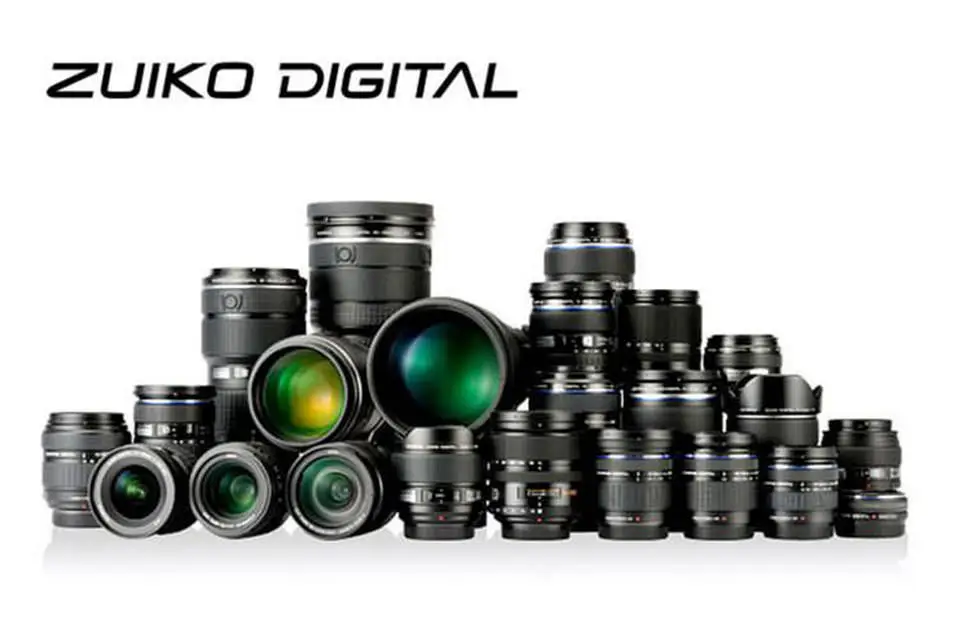
Zuiko Digital is the name of Olympus autofocus lenses for the Four Thirds-system.
Between 2003 and 2008, Olympus introduced a total of 24 ZD lenses,
of which 6 fall into the SHG,
8 into the HG, and 10 into the SG category.
The word Zuiko means "light of the gods" in (ancient) Japanese,
which doubtlessly makes for an attractive marketing term for a line of photography lenses.
It also represents a reference to the Mizuho Optical Research Laboratory
(in Japanese, the first character of the name "Mizuho" can also be read as "zui")
where the company's first lenses were developed. Moreover, the
corporate name before World War II, "Takachiho" means "mountain of the gods" in Japanese,
and, thus, provides another root of origin for the choice of the lens designation. – Olympus
calls its lenses for the Micro-Four-Thirds system M.Zuiko Digital.
Further Reading
Micro Four Thirds has been developing rapidly with the regular
release of new cameras and lenses. Information on upcoming lenses can be found on the
Olympus roadmap
and the Panasonic roadmap. Also, did you ever wonder
how many shots your mFT camera has already taken? Find out on the
Olympus shutter count and the
Panasonic shutter count pages.